24/7 SEATTLE & PUGET SOUND
24/7
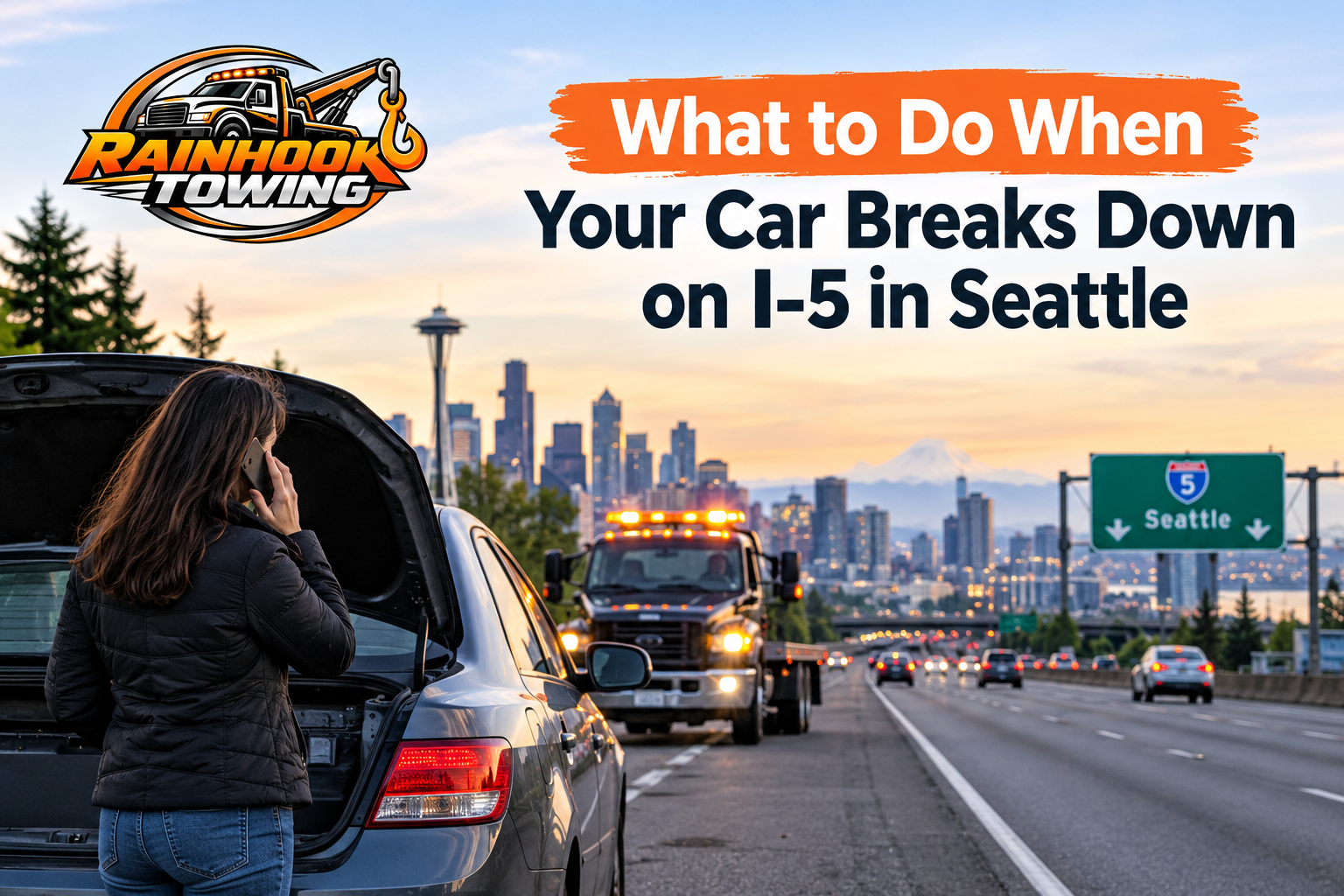
A breakdown on I-5 is stressful in any weather. Traffic moves fast, the shoulder can be tight, and rain or darkness makes your car harder to see. The good news is that a few clear steps can keep you much safer while you wait for help.
This guide walks you through exactly what to do when your car breaks down on I-5 in Seattle, from the first warning signs to the moment the tow truck pulls up. Save it on your phone now so you have it when you need it.
Quick answer If your car breaks down on I-5 in Seattle, steer to the right shoulder or the nearest exit and turn on your hazard lights. Call 911 if you are in a travel lane or feel unsafe. Stay buckled inside the car and away from traffic, then call a licensed tow company and give them your exact location. |
I-5 is the main north and south route through Seattle, and it carries heavy traffic at most hours of the day. Cars pass close to the edge of the road at highway speed. Shoulders can be narrow, and in construction zones there may be almost no room at all.
Seattle weather adds another layer. Rain reduces visibility and makes braking distances longer. At night, a stopped car with no lights on is very hard for other drivers to spot. That is why the first few minutes after a breakdown matter so much. What you do right away can protect you, your passengers, and your vehicle.
The steps below follow the safety advice the Washington State Patrol gives to drivers whose vehicles become disabled: get out of the travel lane if you can, make yourself visible, stay in your vehicle, and call 911 when you are in danger.
The moment you feel the car losing power, steering badly, or shaking, take your foot off the gas and stay calm. Do not slam the brakes. Check your mirrors and signal.
If you cannot reach the shoulder and the car stops in a lane, keep your seat belt on, turn on your hazards, and call 911 right away. Dispatchers can send help and give you safety advice in the moment, which is something a stressed driver might not think of on their own.
Once you have stopped, turn on your hazard lights. They tell other drivers to slow down and move over. If it is dark or raining, leave your headlights and interior dome light on as well, as long as your battery still works.
If you carry reflective triangles or road flares and it is safe to place them, they give approaching drivers extra warning. Only do this if you can do it without stepping into traffic. If the shoulder is narrow or traffic is heavy, skip it and stay in the car.
Who you call first depends on your situation.
You are safely on the shoulder or an exit, no one is hurt, and you just need your vehicle moved. A local company like Rainhook Towing can send a truck to your exact spot. If it is late at night, ask about our 24 hour towing so you are not left waiting until morning.
The faster you can describe where you are, the faster help can find you. On a long freeway, one stretch looks a lot like another, so be specific.
If you are not sure where you are, open the maps app on your phone and share your live location with the dispatcher by text or link. You can also check Washington’s 511 travel information for traffic and road conditions near you.
The Washington State Patrol advises drivers whose vehicles are disabled to stay inside with the seat belt on and call 911 for help. A parked car on a freeway shoulder is not a safe place to stand, so the inside of the vehicle is usually the safest option.
Keep your phone charged and stay on the line if the dispatcher asks you to. If the wait is long and it is cold, run the engine only if the car is safe to run and there is no smoke or smell of fuel.
Before you hand over your keys, take a minute to check a few things. A reputable company will expect it.
If troopers or officers are on the scene, tell them which company you called and follow their directions. If your car is low to the ground, all wheel drive, or damaged, ask for a flatbed tow, which carries the whole vehicle off the road instead of dragging it.
Slow down gradually and move to the shoulder or an exit. Do not change a tire on a busy freeway shoulder unless you are far from traffic and the ground is firm. In most cases it is safer to wait inside the car and call for roadside assistance so a trained driver can handle it.
If the car will not start, turn on your hazards and call for help. A jump start is quick, but it should be done with the car well off the lanes. A professional can test the battery and tell you whether it will keep holding a charge.
If the temperature gauge climbs into the red or steam comes from under the hood, pull over and turn off the engine. Do not open the radiator cap while the engine is hot. Let the car cool and call for a tow rather than driving further, because overheating can cause serious engine damage.
Running out of gas can happen to anyone. Do not walk along the freeway to find a gas station. Call for help and ask about fuel delivery or a tow to the nearest station.
If you are in a crash, call 911 first. If the cars can still be driven and it is safe, move them out of the lanes. Exchange information with the other driver, take photos, and then arrange accident and recovery towing if your vehicle cannot be driven.
Pull over, turn off the engine, and get everyone out of the car right away. Move far from the vehicle and well away from traffic, then call 911. Do not open the hood. Your car can be replaced, and you cannot.
A small kit in your trunk takes a few minutes to put together and can make a long wait much more comfortable.
Check the kit at the start of fall, before the wet and dark months arrive in the Seattle area.
When you are stuck on the side of a freeway, it is tempting to call the first number you find. A little care here can save you stress and money.
You can learn more about who we are and how we work on our contact page, or browse all of our towing and roadside services.
Rainhook Towing is based in Seattle and helps drivers across the area. Our service area includes Seattle, Shoreline, Mountlake Terrace, Lynnwood, Edmonds, Mukilteo, Everett, Marysville, Lake Stevens, Bellevue, Kirkland, and Bothell. If you are along the I-5 corridor, we can help with towing, flatbed transport, and roadside assistance.
Not sure whether we cover your location? Check our service area page or call and tell us where you are. We will tell you what we can do and give you a clear picture of next steps.
Get your car as far right as safely possible, ideally onto the shoulder or an exit. Turn on your hazard lights, put the car in park, and keep your seat belt on. Call 911 if you are in a lane or feel unsafe, or call a tow company if you are safely off the road.
In most cases, stay in the car with your seat belt on. The Washington State Patrol advises drivers with a disabled vehicle to stay inside and call 911 when they need help. If you must leave because of smoke, fire, or a risk of being hit, exit on the passenger side and move well away from traffic.
Call 911 for any emergency, injury, or if your car is blocking a lane. For a car that is safely off the road, call a licensed local tow company or your roadside assistance provider and give them your direction of travel, exit number, and nearest landmark.
Share the direction you are traveling, the last exit you passed or the next one ahead, any mile marker you can see, and a nearby landmark such as an overpass. You can also send your live location from your phone’s maps app.
It is usually safer to wait inside the car and call for help. Passing traffic is fast and the shoulder can be narrow. If you must change a tire, only do so when you are far from traffic on firm, level ground, or better yet, drive slowly to the next exit.
Flatbed towing is often the better choice for all wheel drive vehicles, low cars, luxury or classic cars, and anything with damage. The truck carries your whole vehicle on the bed, so the wheels do not have to roll. Ask the dispatcher which option suits your car.
No one plans for a breakdown on I-5, but a little preparation makes a big difference. Stay calm, get off the road if you can, make your car visible, stay inside, and call for help with a clear location. Keep a small emergency kit in the trunk and save a trusted tow company’s number in your phone before you need it.
If you are stuck right now or want help planning ahead, Rainhook Towing is ready to help. Explore our towing and roadside services, or see how our 24 hour emergency towing works so you know what to expect.